
Hotel Model Room Review: Inside the Hotel Interior Design & FF&E Process
There is a moment in every large-scale hotel FF&E project where the design stops living on a screen and starts living in the real world. For our team at AK Design Group, when a project or client calls for one, the hotel model room review is one of the most revealing, detail-obsessed, and fascinating parts of the process.
We recently completed a model room review for a new-construction lifestyle-branded hotel in the southeast U.S. And if you have never heard of a model room before, you are not alone. Even people adjacent to the industry sometimes picture a miniature replica – a scaled-down version of a hotel room. The reality is quite the opposite, more involved, and a lot more interesting.
What Exactly Is a Hotel Model Room?
A model room is a full-scale, fully built-out version of a hotel guest room, completed before the full FF&E order for the project goes into manufacturing and, ultimately, installation. Every piece of furniture, carpet, tile, window treatment, outlet, wall vinyl, lamp and bulb – it’s all there. For this project, the FF&E was shipped to a vacant retail space within close proximity to the hotel construction site. There, the general contractor built the model room based on the architectural plans and interior design deliverables.
With 125+ guest rooms in the hotel, every detail carries weight and scale. Optimizing light levels so guests feel at ease at the vanity mirror…Confirming that case goods are positioned and finished to hold up under the realities of daily hotel use. Ensuring every fixture feels durable and intentional. As Andrea Gillespie, our Owner & Design Principal said, “These aren’t just aesthetic footnotes; they’re operational realities that housekeeping, guests, and maintenance staff will deal with every single day for the next decade.”

The Economics of Hotel Model Rooms
Our Owner & Managing Principal, David Gillespie, points out “AK Design Group is not recommending that every hospitality interiors project include a model room. For a renovation of a 100-room limited-service hotel, for instance, an owner would rarely need a model room. The brand components are standardized, the design has been replicated and refined across hundreds of locations, and you’ve had years of operational feedback telling you what works and what does not.”
A model room is a meaningful investment, and it makes the most sense in specific circumstances:
When the interior design is highly customized. When there is no brand prototype to reference and every design decision is original, a more advanced review can be essential. The project we are writing about here falls squarely in this category. There was no pre-approved furniture package to plug in. The design was built from a blank canvas, constrained only by architectural requirements and brand standards for quality. AKDG designers specify the furnishings, many of which are being manufactured for the very first time – albeit with vendors that AKDG has vetted through the years on other hospitality projects. We find a look we like, then we work closely with manufacturers to ensure the finished product is commercially viable for the hospitality asset.
When the brand requires it. Major hospitality brands are deeply invested in curating a distinct guest experience. When a project deviates from the standard prototype (a newer brand, a custom build, or a lodging market calling for something elevated), the brand may require a model room as a condition of approval. Brand management and related architecture and design professionals are partners in carving a distinct guest experience that reflects the brand identity and resonates with their target guest and demographic. A model room review ensures the physical environment delivers on that vision before it’s replicated at scale.
When the stakes of getting it wrong are high. New builds with large room counts, fully custom lifestyle brands, first-of-their-kind properties – these are the situations where the math is clear. Finding and fixing a problem in one room is always less expensive than correcting it across every room after the hotel has already opened.
The Client Decision
When a model room is under consideration, the AKDG team develops a full FF&E budget, pricing each FF&E item that will go into the room, and including the associated freight costs to deliver. Simultaneously, the client requests a quote from the general contractor (GC), to physically build out the model room. Once the client has the complete financial picture – FF&E, freight, and build-out all in – they decide whether to approve the model room investment.
This decision involves significant financial investment and additional resources, and an important judgment call. For fully custom projects with large room counts, the business case is usually clear. For smaller or more standardized projects, it’s a legitimate conversation. But, once the client says go, the AKDG procurement team moves quickly on this phase of the FF&E procurement project.

AK Design Group Project Example:
On one recent AK Design Group model-room project, the review encompassed 16 vendors and 46 FF&E SKUs, representing approximately $40,000 in FF&E and freight before contractor and installation costs. This example illustrates why a model room is more than a design review: it is an opportunity to validate specifications, coordination, cost assumptions, and installation details before those decisions are repeated across the property.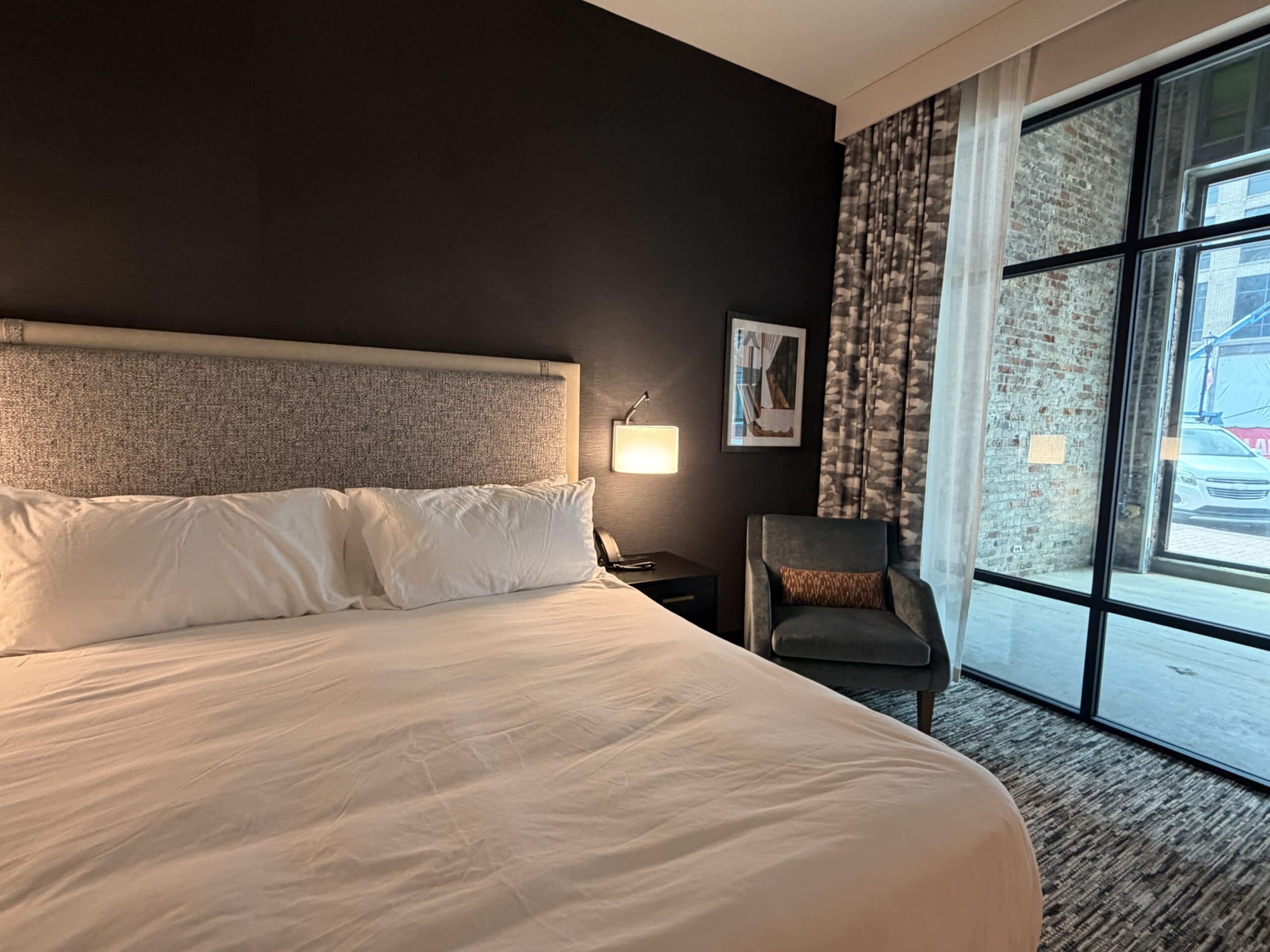
Model Room Pricing
Getting the model room FF&E to the construction site in good condition, on schedule, and at a manageable cost is more complex than it sounds, especially when the pieces are fully customized and many have never been manufactured at scale.
One thing that surprises people is the pricing dynamic involved. For a manufacturer, building a single custom piece carries almost none of the economies of scale of a full production run, but it carries nearly all of the setup costs. The shop drawings alone are extremely labor-intensive as these are the documents that detail how the item will be built, what materials get used, and how finishes are applied. Manufacturers are understandably reluctant to invest in a project without some assurance the full order is coming. David said, “Some vendors might not want to go through the exercise of the additional shop drawing and setup labor without assurances that they’re being awarded the full project. That’s where our FF&E procurement team comes in – these vendors know us and trust us.”
In practice, and if the client is working with a reputable hospitality interior design and FF&E procurement company, some vendors may provide their model room pieces at significant discount to earn the full production contract. Other vendors may require a confirmed purchase order before they will begin shop drawings. On this case study project, one key manufacturer provided the model room FF&E at no cost – a strategic decision to earn the business. Andrea said, “It’s a relationship-driven process, and the vendor cooperation our clients benefit from is a direct result of trust built over years developing a network of quality FF&E manufacturers.”
Multiple Opinions and an Overlooked Benefit
One of the things that makes a model room review so valuable – and so lively – is who shows up to review it after the construction. For this project, the meeting included the hotel owner/developer, representatives from the brand’s architecture and interior design review team, the project architect, the management company that will run the hotel, and even the management company’s marketing representative. That’s a lot of opinions, and that’s entirely the point. Every stakeholder brings a different, valuable perspective. The brand’s design team is thinking about standards compliance. The management company is thinking about operations. The owner is thinking about budget and longevity. Our design team is thinking about all of it at once.
It is not only the quality of the furnishings on full display – it is also an important opportunity to visualize how finishes have been installed and how all the pieces come together. The contractor’s attention to detail with any minor field modifications, ensuring electrical is located properly, installing artwork at the right heights, laying carpet to optimize yield, et cetera. This is a chance for alignment on installation expectations, an often-overlooked benefit of the preliminary installation that occurs during the model room review.
The Details You Would Never Catch in a Rendering
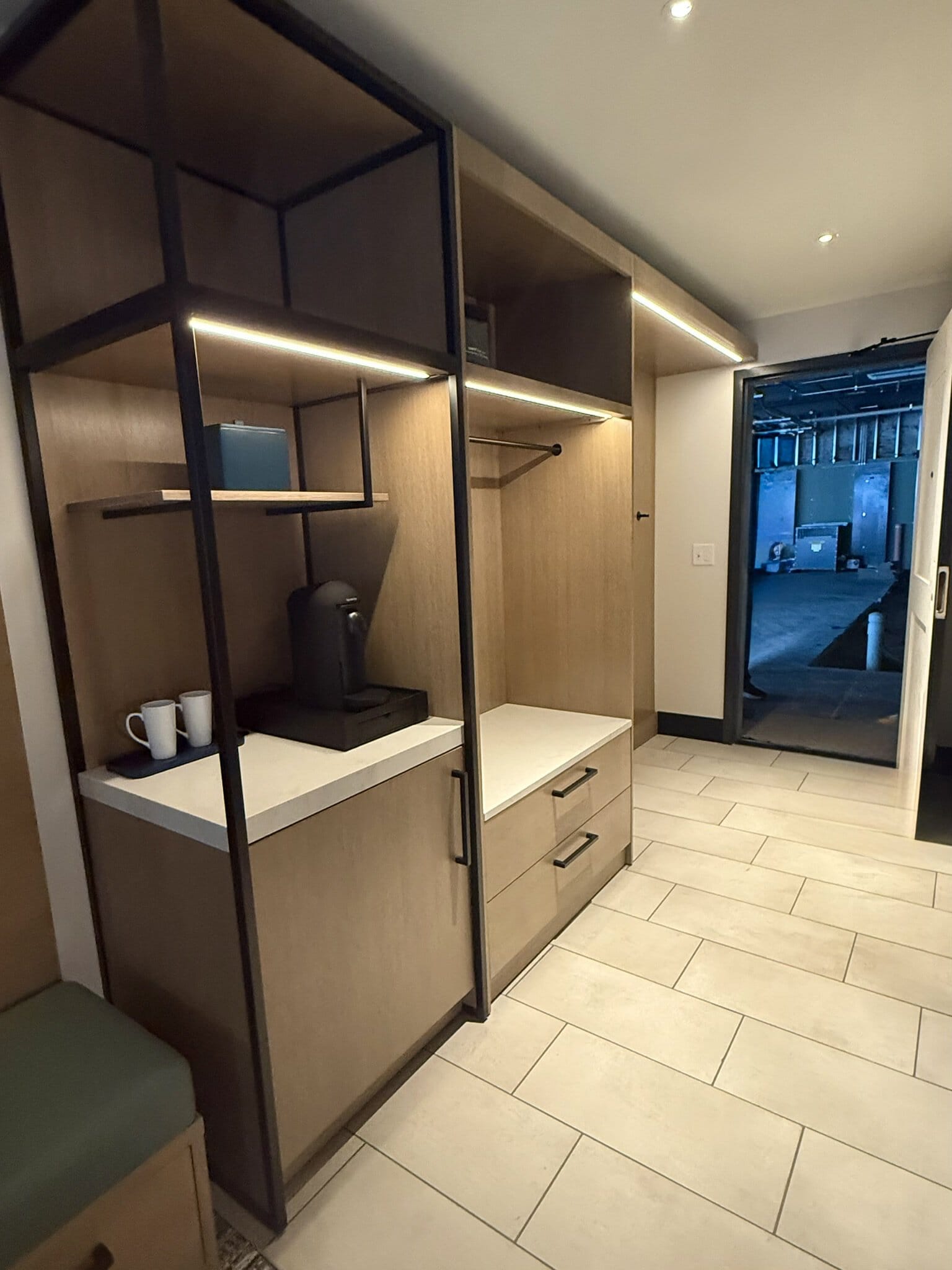
During a recent model room review, our design team observed that a corner of the furniture unit near the entry door was likely to realize suitcase impact. Guests rolling a suitcase into the room would likely clip it repeatedly over time. The fix? Add metal corner protection, matching what was already in place on the opposite side near the coffee station. It’s a small detail. It’s also exactly the kind of thing you would never catch from a rendering.
In another small adjustment, one member of the project team sat down in the task chair at the desk and commented that it felt too low – not dramatically wrong, just subtly off in a way that would translate to an awkward, arms-too-high posture for a guest trying to use their laptop. The seat height was adjusted by a half-inch.
Our design team also came prepared with lessons learned from previous projects. On past jobs, case goods were designed to reach all the way to the ceiling – which sounds clean and intentional, until the ceiling comes in at 8’11” instead of the planned 9’0″. On this project, the team built in intentional clearance at the top to account for exactly that kind of construction variance.
Installation Logistics
One constraint that shapes the FF&E design long before manufacturing begins is the building itself. By the time guest room FF&E is ready to be installed, a hotel is typically fully enclosed – walls finished, windows in, elevator cabs fixed. Every piece of furniture heading to an upper floor must travel through that elevator, which means every piece must also be designed and packaged to fit.
On this project, the AKDG FF&E procurement team mapped the elevator cab specifications early in the process and worked out exactly how every piece of the FF&E would need to be dimensioned and packaged to move through the building.
One large TV panel, for example, had to be engineered as a knock-down piece – built with a seam so it could be disassembled for transport and reassembled on-site. It is the kind of planning that happens well before anything ships, and it only works when the design and procurement teams are thinking about it together from the beginning.
Putting the Observations into Action
Once the walkthrough is complete, the work shifts from observation to implementation. Someone on the design team consolidates the feedback – every comment, every adjustment, every request from the owner, the brand, or the management company – and determines what actually needs to change.
What you are most likely to see are changes to the design specifications: a different material finish on the top of a dresser, a steel corner guard added to protect against luggage impact, a lampshade swap, curtains that need to be installed at ceiling height rather than lower on the wall, or confirming that power and data outlets align with where furnishings actually land in the room.
Our FF&E procurement team then makes sure all of those updated specifications get communicated clearly to every relevant vendor. In some cases that triggers revised shop drawing reviews and the manufacturers must adjust their fabrication documents and get AKDG approval of these revisions before manufacturing can proceed.
These adjustments sometimes carry minor cost increases, but can often lead to significant operational or guest experience improvement. Adding a steel corner guard might run an extra $20 per room. But in the context of a full FF&E investment that runs into the millions, those per-item changes are relatively insignificant. The model room exists to surface these issues when addressing them is still efficient and affordable.
A Look Behind the Scenes
Whether you are a developer evaluating your next project, a hospitality design student curious about what the industry actually looks like from the inside, or someone who just wants to understand what an interior design firm does beyond the pictures – we hope this gives you a clear picture about on interesting aspect of our business.
If you are thinking through an upcoming project and wondering whether a model room is worth it, we would be glad to talk through what’s involved.
AK Design Group specializes in interior design and procurement for hospitality projects. Contact us today to start a conversation.

Frequently Asked Questions About Hotel Model Rooms
What is a hotel model room? A hotel model room is a full-scale, fully furnished mock-up of a single guest room, built before the rest of the FF&E goes into manufacturing and then installation. It includes nearly every piece of furniture, fixture, electrical outlet/switch, and every finish – constructed to exact specification so that the client, brand, design team, and other stakeholders can evaluate the room in person before committing to full production. Unlike a miniature architectural model or a 3D rendering, a model room is a real, almost-livable space you can walk into, touch, sit in, and critique.
How much does a hotel model room cost? The cost varies by project size, design complexity, and how much vendor cooperation you are able to negotiate. At minimum, it involves procuring every piece of furniture and fixture that will be used in the room – with no volume discount and, in some cases, meaningful unit price premiums. Freight, general contractor build-out, and space lease costs add to the total, as does travel for the full team and brand representatives. For reference, the model room discussed in this article – represented a single room type and included 16 vendors and 46 unique item numbers or SKUs. Excluding contractor and installation costs, AKDG provided the procurement service and all FF&E items, including corresponding ocean, domestic and air freight for approximately $40K.
When does a model room make sense? A model room makes the most sense for new builds with large room counts, fully custom designs, or projects where the brand requires one as a condition of approval. It is generally not necessary for standard prototype renovations where the design is well-established and brand-prototype.
Does the brand require a model room? Sometimes, yes. Major hospitality brands are deeply invested in the guest experience, and they may require a model room for projects that deviate from the standard prototype – particularly newer brands, fully custom designs, or markets where elevated design is expected. Even when the brand does not mandate it, they often strongly encourage it. The brand’s architecture and design review team typically participates in the walkthrough and submits formal approval before full production can proceed.
Do we have enough time to do a model room? This is one of the most important questions to ask early, and it requires a solid understanding of lead times for both the model room FF&E and the full production order. The model room review needs to happen early enough that feedback can be incorporated before the full production order is finalized, but late enough in construction that real-world dimensions can be confirmed and the building is far enough along. Threading that needle requires working backward carefully from the project’s target opening date – and it’s why having an experienced interior design and procurement partner makes such a difference.
What kinds of things can be identified and corrected during a model room review? The range is broader than most people expect. Common findings include furniture dimensions that conflict with as-built ceiling heights, pieces that won’t fit through the building’s elevator cab once the structure is enclosed, and lighting levels that feel very different in person than they appeared in a rendering. Reviews also surface ergonomic issues that only reveal themselves when someone actually uses the space – a desk chair that feels a little too low, a vanity mirror at a low height, a closet rod positioned awkwardly for reaching. Durability concerns come up frequently too: corners that will take damage from rolling luggage, materials that won’t hold up to daily cleaning, hardware that guests will instinctively try to adjust. And sometimes it’s purely operational – are there enough power outlets? Is there a logical place to steam clothes? Can guests find somewhere obvious to hang a wet umbrella? The model room is where all of these questions get answered before they become permanent features.
Can you reuse the model room FF&E for the full project? Technically, some items could be reused – and in some cases, model room pieces do end up as “attic stock” (spare inventory kept on or off the property for use when something gets damaged). However, we generally advise against counting on model room pieces as part of the full FF&E count. The purpose of the model room is to identify things that need to change – and in anticipation of those modifications, we place the full production order at full quantities without subtracting the model room pieces. Those pieces then serve as a buffer: useful if something is damaged during construction or installation, but not something we are counting on to fill a room. And practically speaking, not everything makes sense to store indefinitely. Nobody wants to warehouse an extra platform bed.