
SHOP DRAWINGS IN HOSPITALITY INTERIOR DESIGN

What Is a Shop Drawing?
Before customized FF&E or millwork gets manufactured or constructed for an AK Design Group hospitality project, the manufacturer or contractor submits a shop drawing for our review and approval. Shop drawings are technical drawings detailing exactly how the item will be constructed.
Why Are Shop Drawings Important in Hospitality Interior Design?
Repetition magnifies every decision.
For a hospitality design project where a custom item may be produced several hundred times, ensuring the drawing is right matters significantly: an incorrect dimension in a shop drawing doesn’t become one wrong chair or nightstand – it becomes 200 of them. This is why AK Design Group reviews shop drawings thoroughly on behalf of its clients – verifying dimensions, safety and accessibility requirements, finishes, design intent and other factors before manufacturing and construction begins.
The Importance of Proven Manufacturers
Before a manufacturer is specified by AK Design Group, it already has a proven record of delivery performance, product quality, and durability on successfully completed projects. AKDG works extensively with hospitality-focused manufacturers, so both sides begin with a shared understanding of what hotel FF&E requires: commercial-grade, brand-compliant products built to perform in demanding environments.
That means the shop drawing review is not starting from scratch. By the time a drawing reaches our team, much of the groundwork has already been done through careful manufacturer selection. The review then becomes another layer of quality control, focused on making sure the specific item is being built as designed, while keeping the project moving on schedule and within budget.
Which Items Require a Shop Drawing (and Which Do Not)
Seating, casegoods, custom decorative lighting, and millwork like registration desks, bars, cabinetry, and vanities typically receive shop drawing attention from AK Design Group. In addition, if any “prototype-inspired” item has been modified or customized, AKDG will request a shop drawing from the manufacturer.
Not every category of FF&E requires a shop drawing. For example, window treatments are “field-verified”, meaning a representative of the manufacturer physically travels to the project site and takes their own on-site measurements, with order details confirmed through the quote rather than a shop drawing. Artwork is approved through an image deck and frame samples.

Hospitality carpet is in a category of its own. The manufacturer provides a diagram laid over the floor plan, showing where material widths line up and carpet seams fall. A “flooded floor plan” is provided when a patterned carpet needs to show the GC and flooring sub-contractor how the product should be installed around a corner in a corridor, for example. These flooring-specific due diligence products are not technically called shop drawings, but they serve a similar purpose and are reviewed by AKDG before purchase orders are submitted. For flooring specifically, AKDG is looking to maximize yield and minimize product waste, a step that can save an owner tens of thousands of dollars, depending on the type of flooring and the size of the hotel.
What Product Attributes are Reviewed in a Shop Drawing?
Dimensions – All Products, including Millwork
- Length, width, depth, height, weight, diameter, circumference, thickness
Finishes & Hardware – Samples of all Products, including Millwork
- Color, sheen, stain
- Paint, powder coat, metallic finish
Lighting-Specific Products
- Voltage, lamping/bulbs, and switching
- Hardwired vs. power cord
- Dimensions (described above)
- Finish of fixture and shade
- Power incorporation into the base, as applicable
- Pole/cord/chain length, coordinated with ceiling height to determine whether additional length is needed to bring the fixture to the height specified in the design drawings
Upholstered Seating Products
- Foam weight, density, and type
- Dimensions as noted above in addition to seat back height, seat height (from floor), seat depth, arm height
- Coordination of seat height and arm height with table or bar clearances
- Stain finish on frame
- Metal footrest on barstools
- Metal finish on details, if applicable
- Nailhead trim, if applicable
- Fabric placement – front of back, seat, apron, etc. – confirmed against the drawing
- Sleeper sofas: mechanism and mattress size/type
*AKDG addresses fire code compliance for seating at the specification level, not during shop drawing reviews.
Inside the Review Process
Once a shop drawing arrives from the manufacturer or general contractor, the review is rarely a single pass. Our design team marks it with “red lines”, and the manufacturer or millwork shop returns a revised version. Changes are typically “clouded” by the manufacturer, allowing the AKDG reviewer to quickly confirm that each comment was addressed without re-checking the entire drawing.
When revisions are missed by a manufacturer, a phone call can often resolve the challenge more efficiently than another round of emailed red line markups. AKDG calls this a “page-turn”, where both sides review the drawing together in real time, working through questions and revisions page-by-page.
Design Intent vs. Fabrication Responsibility
Responsibility follows scope. Our team reviews the finishes, dimensions, details, and overall design intent of the FF&E items and millwork AKDG designs or specifies. Items within the architect’s scope are routed to the architect.
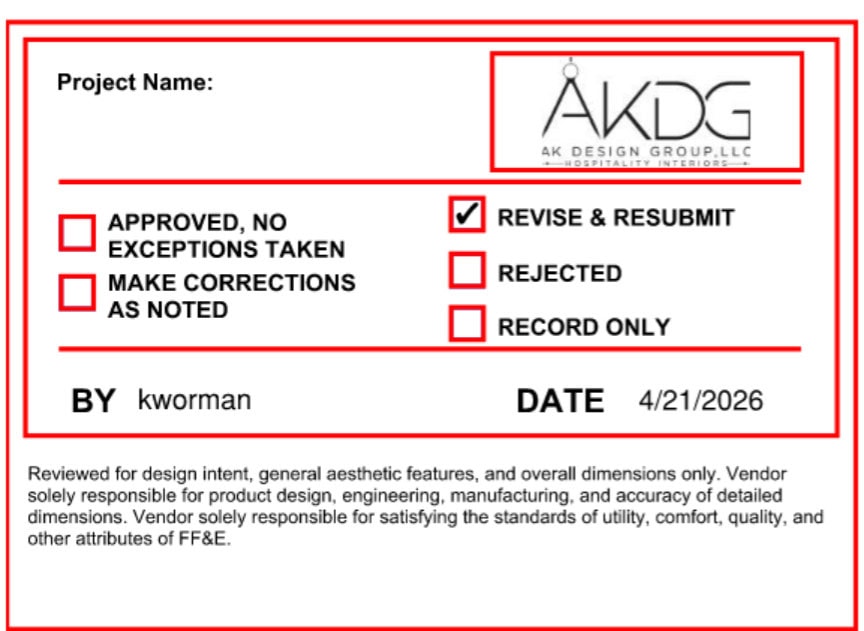
The AKDG approval stamp, pictured below, reflects that boundary as well. AKDG reviews for conformance with the design intent, while fabrication methods and engineering remain the responsibility of the manufacturer or millworker. Where dimensions depend on site conditions, AKDG will add a “field verify” note before fabrication moves forward.
This work happens largely behind the scenes. But every markup, revision, page-turn, and field verification is another opportunity to catch a problem before it becomes a mistake in fabrication or installation, or a delay in the grand opening or re-opening of the hotel.
AK Design Group specializes in interior design and FF&E procurement for hospitality projects. Contact us today to start a conversation.
Frequently Asked Questions About Shop Drawings
What is a shop drawing? A shop drawing is a detailed technical drawing a manufacturer uses to fabricate a piece of FF&E or millwork. It shows the dimensions, finishes, and construction details needed to build the piece exactly as specified.
Are shop drawings included in AK Design Group’s interior design contract? Yes. Reviewing shop drawings is part of AKDG’s design services on any project where AKDG provides interior design – regardless of whether AKDG is also managing procurement or the client is working with a separate procurement team.
What is the difference between FF&E shop drawings and millwork shop drawings? FF&E shop drawings come from the manufacturer once a purchase order is placed, typically routed through the purchasing team. Millwork shop drawings come from the general contractor’s millwork or carpentry subcontractor later in construction.
What types of hotel brands will need significant effort in shop drawing reviews? Lifestyle brands (think Motto, Tempo, Tapestry, Autograph, and other lifestyle concepts) tend to require significantly more shop drawing review than a standard prototype-driven brand. These brands lean into customization: chairs resized to fit tight footprints, custom finishes, and millwork built specifically for that property rather than pulled from an established prototype. That level of customization is exactly what drives more shop drawing review. Every custom piece needs its own verification, rather than falling under an already brand-approved prototype.
When do shop drawings happen in a hospitality design project? FF&E shop drawings typically appear during the construction phase, after the design intent and plans are already approved. Millwork shop drawings tend to come later in the construction timeline.
Who is responsible if a shop drawing error makes it to production?If a manufacturer deviates from an approved shop drawing, the manufacturer is responsible for the correction. Review on the designer’s end is limited to design intent – dimensions and finishes – not structural engineering, which remains the manufacturer’s or millworker’s responsibility.
Does every FF&E item get a shop drawing? No. Seating, case goods, custom decorative lighting, and millwork typically require one. Window treatments, artwork, and wall coverings do not – carpet uses a seaming diagram instead.
Where do FF&E and millwork shop drawings have to agree? Details like seat height, apron clearance, and legroom span both drawings. If a seat height and the millwork apron underneath do not line up, the two need to be adjusted together.
How do brand standards factor into shop drawing review? Brand standards rarely dictate dimensions, but they do require contract-grade construction – addressed upfront with a standard set of general notes included with every shop drawing package.
Who approves shop drawings when a client manages procurement through a third party? The design team still reviews shop drawings for the pieces it designed, regardless of who is handling FF&E procurement. If an owner manages procurement independently without design oversight, that review step is sometimes missed entirely.
What can be interpreted from manufacturer performance during the shop drawing review process? Manufacturer responsiveness during shop drawing reviews is often a leading indicator of overall project performance. When a manufacturer struggles at this stage, AKDG takes notice and can recommend a change before it impacts the project schedule.